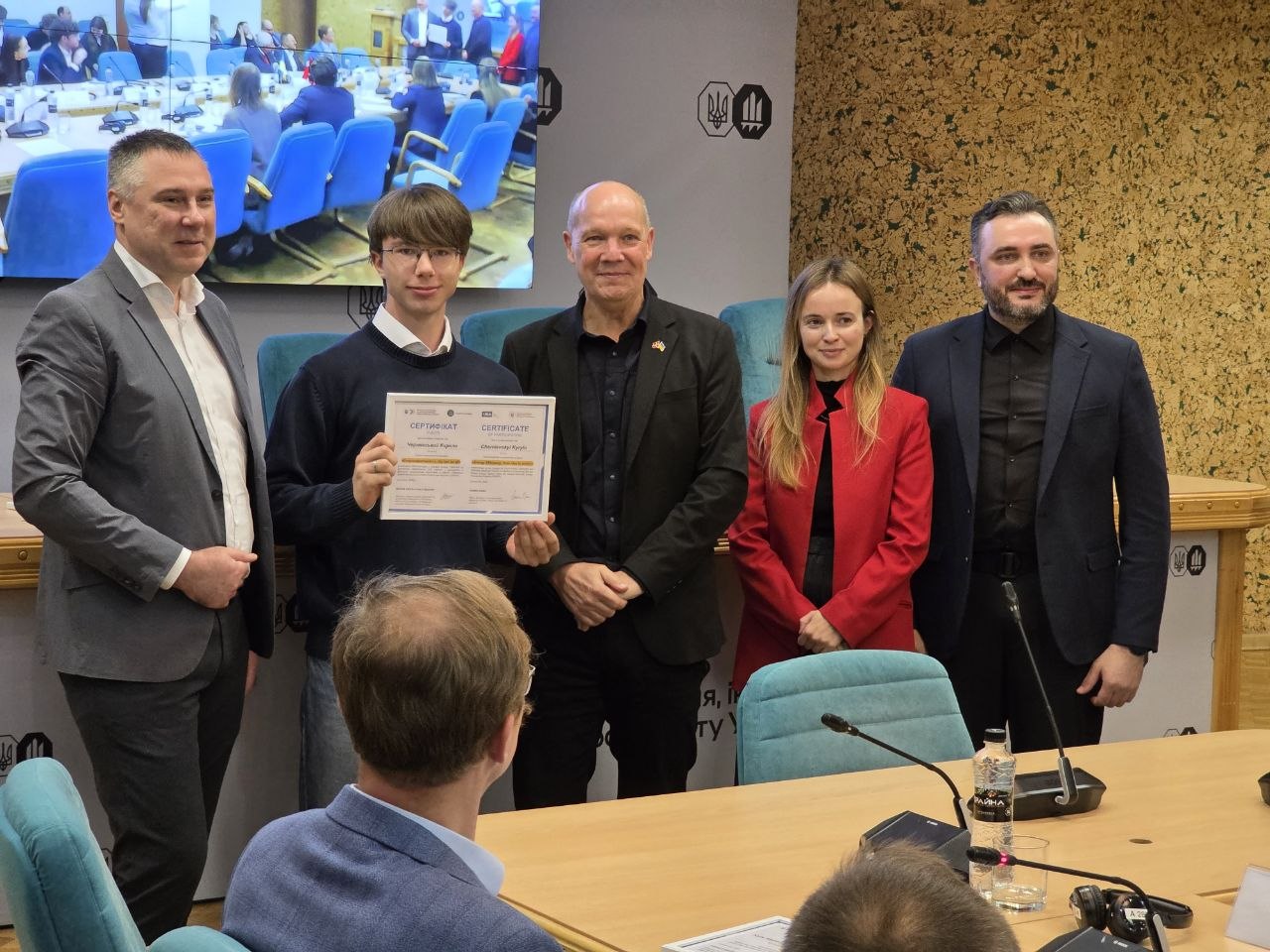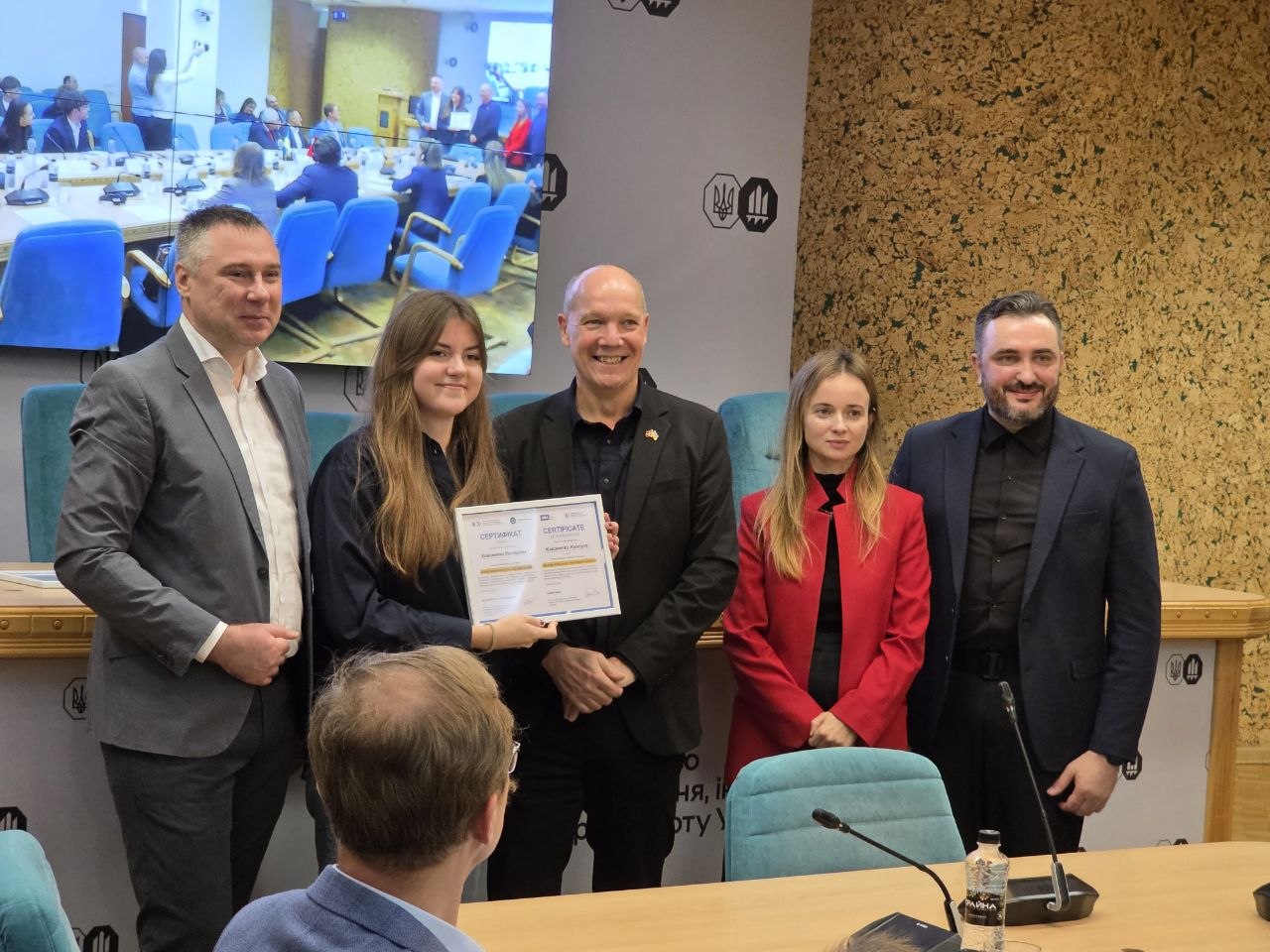
This spring, students from our department joined the Ukrainian-Danish project “Energy Efficiency: From Idea to Action”. Since then, they have visited enterprises and energy facilities in Ukraine, taken part in training in Denmark, learned about European approaches to energy saving and worked on their own projects for Igor Sikorsky Kyiv Polytechnic Institute. On 22 October 2026, a final meeting was held in the conference hall of the Ministry for Communities, Territories and Internally Displaced Persons of Ukraine, where student teams presented their results. The project was implemented within the Ukrainian-Danish Energy Partnership Programme (UDEPP), bringing together three universities: Igor Sikorsky Kyiv Polytechnic Institute, Kyiv National University of Construction and Architecture, and Taras Shevchenko National University of Kyiv.
KPI was represented by Kateryna Kononenko, Ivan Kot, Dmytro Pysarenko and Kyrylo Cherniavskyi from the Educational and Research Institute of Energy Saving and Energy Management, and Dmytro Lienkov from the Educational and Research Institute of Nuclear and Heat Power Engineering. The team’s participation was coordinated by Olena Borychenko, Head of the Department of Power Supply, and Anatolii Cherniavskyi, Associate Professor at the department and Director of the Institute’s Energy Managers Training Centre.
For students of the Department of Power Supply, the programme was particularly valuable as an opportunity to see how energy efficiency challenges are addressed in practice.
During their study visit to Denmark, participants visited the Danish Energy Agency, the Technical University of Denmark and the University of Copenhagen, and learned about the City of Copenhagen’s experience in energy management and energy efficiency. They also visited Amager Resource Center, a facility that uses household waste to produce heat and electricity.
After returning home, the students faced a practical task: to propose ways to promote energy saving and more rational use of energy resources at their own university. Our team began with a survey of KPI students to understand their interest in energy efficiency and willingness to change everyday habits. More than 93% of respondents recognised the importance of energy efficiency, but only about half regularly followed energy-saving practices.
These findings helped the team identify priorities for further work.
One of the main ideas was the “EnergoCampus” platform: a shared information space where users will be able to find energy efficiency materials, share proposals and learn about student initiatives.
Another development is a Telegram bot through which students will be able to report problems related to the use of energy resources in academic buildings and dormitories, such as faulty heating, windows left open in winter or water leaks.
At the same time, the students prepared information posters featuring KPI’s mascot and themed stickers with simple tips for saving electricity, heat and water.
A separate area of work focuses on practical energy assessments of university buildings. This provides an opportunity to apply knowledge gained at the department: assessing heat losses, using thermal imaging equipment and analysing ways to improve the energy efficiency of academic buildings and dormitories.
The KPI team presented all these developments at the project’s final meeting. The event brought together representatives of Ukraine and Denmark, university management, lecturers and students. KPI was also represented by its First Vice-Rector, Mykhailo Bezuhlyi.
Following the presentations, participants discussed the results and opportunities to continue the student initiatives. The event concluded with the presentation of certificates.
For the department, it is valuable that the students gained not only new knowledge and experience of international communication. They also organised their own project work, conducted research, proposed technical and information solutions, and presented them at the final event.
Much work still lies ahead. We hope that EnergoCampus will continue to develop, student energy assessments will become a regular activity and more of our students will join these initiatives.
We thank all participants and organisers for this opportunity and congratulate our students on successfully completing the programme. We hope that the ideas developed through the project will continue to grow at KPI.
Photo gallery