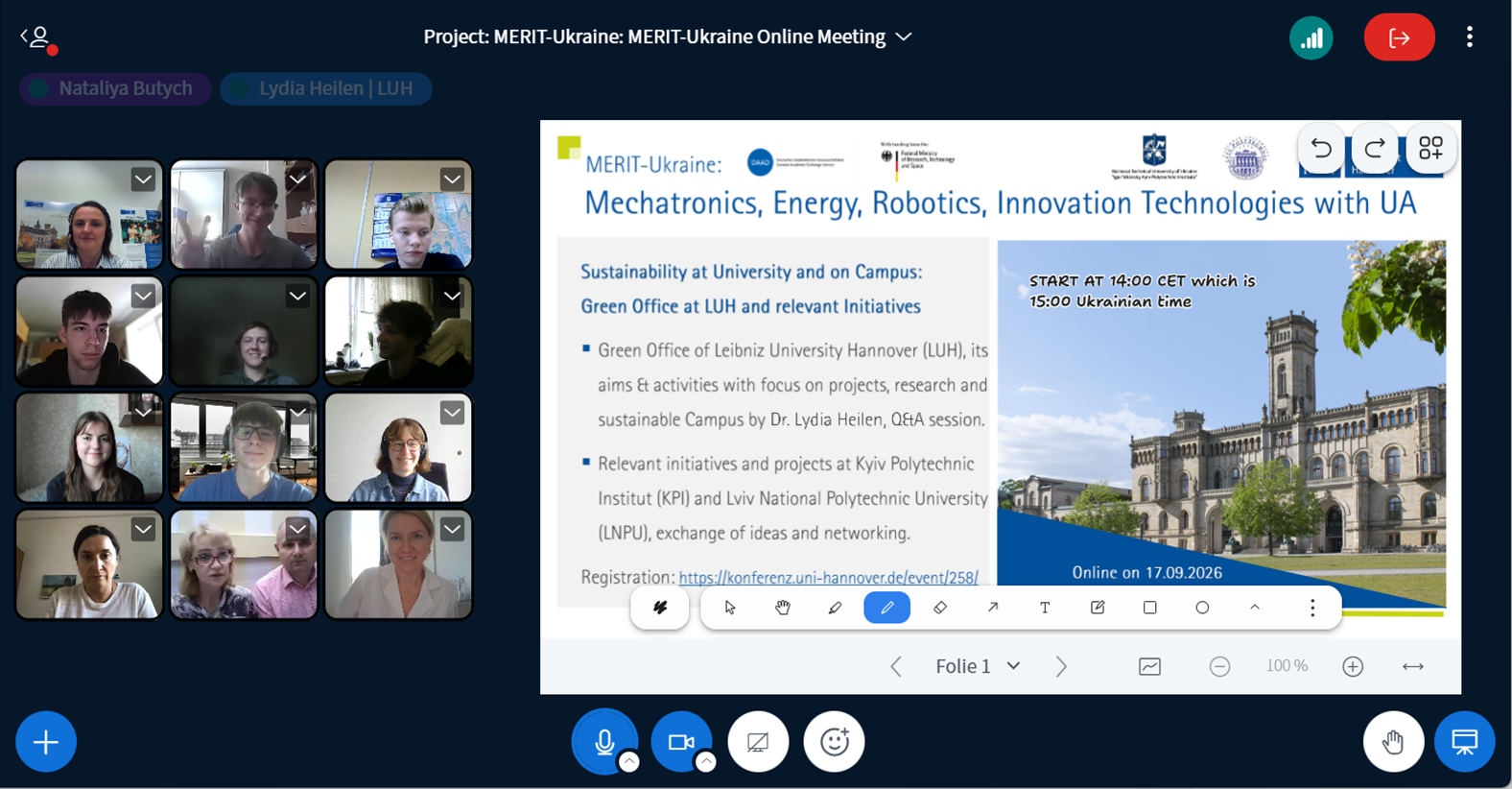
On 17 September 2026, representatives from the Igor Sikorsky Kyiv Polytechnic Institute, Lviv Polytechnic National University and Leibniz University Hannover met online to discuss universities’ initiatives towards sustainable development. The event took place as part of the joint MERIT-Ukraine project, supported by the German Academic Exchange Service (DAAD).
During the meeting, Dr Lydia Heilen, Head of the Green Office at Leibniz University Hannover, presented her department's main areas of work. The Green Office is a coordination centre for sustainability, climate protection and environmental issues. The team consists of 12 employees and 5 student assistants. In 2023, the Green Office presented an updated version of the Integrated Climate Protection Concept. The concept sets out measures to achieve the university’s climate neutrality by 2031 and covers eight areas:
A. institutionalisation of climate protection;
B. investment and non-investment measures relating to buildings and the campus;
C. environmentally friendly mobility;
D. environmentally responsible procurement;
E. development of renewable energy;
F. involvement of the university community and communication;
G. regional cooperation;
H. monitoring of results and management of the implementation of measures.
Lydia Heylen went into more detail about specific projects from recent years – the comprehensive refurbishment of one of the university’s buildings to improve energy efficiency and integrate rooftop photovoltaic systems; initiatives relating to urban gardening on campus; the organisation of a free bicycle hire scheme for students (up to 30 minutes per day); and the gradual installation of charging points for electric vehicles.
Igor Sikorsky Kyiv Polytechnic Institute was represented by a team led by Oleksandr Myronchuk, Vice-Rector for Scientific and Pedagogical Work (Infrastructure Development). In his presentation, Oleksandr Myronchuk outlined the university’s key policies in the areas of social responsibility, inclusion, academic integrity and environmental protection, and also presented KPI’s position in international rankings that assess universities’ contributions to achieving the Sustainable Development Goals.
Dmytro Yatsenko, a lecturer at the Department of Power Supply, presented the activities of the Energy Management Service at Igor Sikorsky Kyiv Polytechnic Institute. In his presentation, he outlined the service’s main areas of work and highlighted the challenges facing the university in the context of full-scale Russian aggression – ensuring the energy resilience of the university’s infrastructure, the rational use of energy resources, and the search for practical solutions to maintain campus operations amidst the risks posed by the war. The speaker paid particular attention to educational and awareness-raising initiatives in the field of energy management and sustainable development. In particular, he described the integration of relevant university-wide disciplines into master’s-level study programmes and the activities of the Training Centre for Energy Managers at Igor Sikorsky Kyiv Polytechnic Institute.
Students from Igor Sikorsky Kyiv Polytechnic Institute joined the online session to showcase their own initiatives aimed at promoting energy efficiency and the principles of sustainable development on the university campus. These included the ‘EnergoCampus’ information platform, which helps to engage the student community in creating an energy-efficient and environmentally responsible university community.
Towards the end of the meeting, participants discussed opportunities for further exchange and launch of joint projects, educational events, and student initiatives to support sustainability at university and on campus.
Yulia Chernetska