Bogdan Demchenko and Vitalii Palii – students of the IEE Power Supply Department at the Igor Sikorsky Kyiv Polytechnic Institute, enrolled in the second-cycle (Master’s) degree programme in ‘Energy Management and Energy-Efficient Technologies’, have been awarded scholarships under the Erasmus+ programme for academic mobility to study during the spring semester of the 2025/2026 academic year at the University of South-Eastern Norway. Both students successfully passed exams on specialized subjects in the field of electrical power engineering at the host institution and returned to Ukraine to complete their studies under the educational program. Ahead lies their pre-graduation internship and the preparation of their Master’s thesis, and now is the time to briefly summarise the results of this academic mobility programme.
Bogdan Demchenko’s feedback on his experience of studying abroad can be found via the link; below is Vitalii Paliy’s reflection.
The aim of the academic mobility programme was to deepen theoretical knowledge, gain cutting-edge practical experience in the field of electric power engineering and renewable energy sources, and familiarise myself with European energy management standards. The course content covered the study of modern methods of power system control, the investigation of dynamic processes in networks, the analysis of power electronics, and the design of smart grids.
The course took place at the University of South-Eastern Norway (USN). This institution is one of the country’s leading centres for technology and engineering. The university’s engineering department, where the training took place, is equipped with state-of-the-art laboratories, specialised software for computer modelling of electrical circuits, and a robust research infrastructure. The learning process was based on a combination of lectures, interactive seminars, independent research work and the practical resolution of real-world industrial case studies.
What I liked most was the practical approach to learning, where theory is always underpinned by real-world case studies. During the semester, I studied Power Electronics and Electrical Drives under the supervision of Kjetil Svendsen, Power System Operation and Smart Grid with Professors Sanjeevikumar Padmanaban and Gunne J Hegglid, Power System Components (taught by Elin Fjeld) and Power System Dynamics (taught by Professor F. Gonzalez-Longatt). The lecturers constantly encouraged us to think critically. As part of the Power System Dynamics course, a series of computer simulations was carried out to investigate the behaviour of power systems during emergency and normal transient processes.
The work was based on the use of two complementary software packages. The main focus was on computer modelling and the stability analysis of power systems. It is worth noting that although the lectures were delivered remotely, the teaching was organised to a very high standard. The material was presented clearly and comprehensively, and communication with the lecturer remained effective, enabling us to master the course content fully and without any difficulties.
One of the most fascinating parts of studying at USN was the practical laboratory work, where we had the opportunity to move away from computer simulations and work with real power equipment. Under the guidance of lecturer Kjetil Svendsen, we explored the principles of controlling electric machines using semiconductor converters. I particularly remember the assignment where we assembled a three-phase voltage source inverter circuit using IGBT transistors to control the speed of an induction motor. It was a real engineering delight to see how changing the parameters of the control algorithm (for example, the modulation index) instantly affected the speed and acoustic noise of a real physical motor, whilst the oscilloscope recorded the corresponding changes in the harmonic spectrum. This hands-on experience of assembling circuits ‘by hand’ allowed for a much deeper understanding of the physics of power electronics processes than is possible through textbooks or computer models alone.

Equally important and practically oriented was the laboratory workshop on the subject of Power System Components, which was led by Elin Fjeld. This course enabled us to study the ‘hardware’ of power systems in detail – power transformers, high-voltage circuit breakers, cable lines and insulating structures – combining theoretical calculations with real-world testing. The most memorable part of the course was carrying out practical work in the university’s high-voltage laboratory, where we investigated the dielectric strength of insulating materials and the switching characteristics of protective equipment. Working in the high-voltage laboratory provided a clear understanding of the physics of the processes occurring in real equipment under load. The experience of working with such components ‘in real life’ enabled us to gain a much deeper understanding of the principles of designing and operating reliable electrical networks.

In addition to the intensive academic programme, the host institution organised an excellent cultural and social programme, which greatly helped students from different countries to settle in and bond. One of the most memorable group activities was a curling trip organised by the university. For many of us, it was our first opportunity to try our hand at this traditional Scandinavian winter sport. The event left us with many positive memories and proved to be a wonderful experience of teamwork outside the lecture theatres.

In addition, to foster a friendly atmosphere and encourage ongoing informal socialising, the university introduced a wonderful tradition – weekly ‘Coffee Hours’. These were regular, cosy get-togethers where local and international students could come together, have a coffee, discuss the latest news, share their experiences of university life and simply have a pleasant chat. This format was ideal for overcoming the language barrier, forging friendships and immersing oneself deeply in USN’s multicultural student environment.
Undoubtedly, the most valuable outcome of this programme, apart from the knowledge I gained, was that I managed to make many good friends from all corners of the world. Shared interests, our studies and a desire to explore a new country quickly brought us together as one big team.
As well as official university events, we started organising our own trips entirely independently, which allowed us to get to know Norway’s unique nature and culture as deeply as possible. As outdoor activities became our shared passion, we put together a packed itinerary:
Ski trips (Kongsberg and Vrådal): for me, this was a truly special experience, as it was in Norway that I went skiing for the very first time in my life. We organised a trip to Kongsberg and Vrådal to go skiing. It was a wonderful experience of winter thrills.

Oslo: We have explored the Norwegian capital in detail, including its architecture, museums and the rhythm of life in the country’s main metropolis.

Bergen: After hiring a car, we set off for Norway’s cultural capital to see the famous Bryggen waterfront for ourselves and explore the magnificent western fjords.

Tromsø: This trip beyond the Arctic Circle was, perhaps, the most magical part of the whole programme. The main aim of our visit was to ‘hunt’ for the Northern Lights. And we were in luck! Standing under the stark Arctic sky at night and watching with our own eyes as it shimmered with bright green waves is a sight that simply takes your breath away. It is impossible to fully convey those emotions in words or even through photographs.

The Lofoten Islands: A true gem of our travels and a test of our adventurous spirit. To get as close as possible to the wild Scandinavian countryside, we decided not to book accommodation, but instead set up camp and spent the nights in tents. The biggest natural shock for us was the phenomenon of the midnight sun – in Lofoten, the sun simply never sets below the horizon. Your usual sense of time completely disappears when you’re sitting outside your tent at two in the morning, and it’s as bright as day all around you. Sleeping in tents under this endless sun, waking up to a view of jagged cliffs rising straight out of the ocean, and breathing in the salty air – it’s a surreal and utterly unforgettable experience of a true expedition.
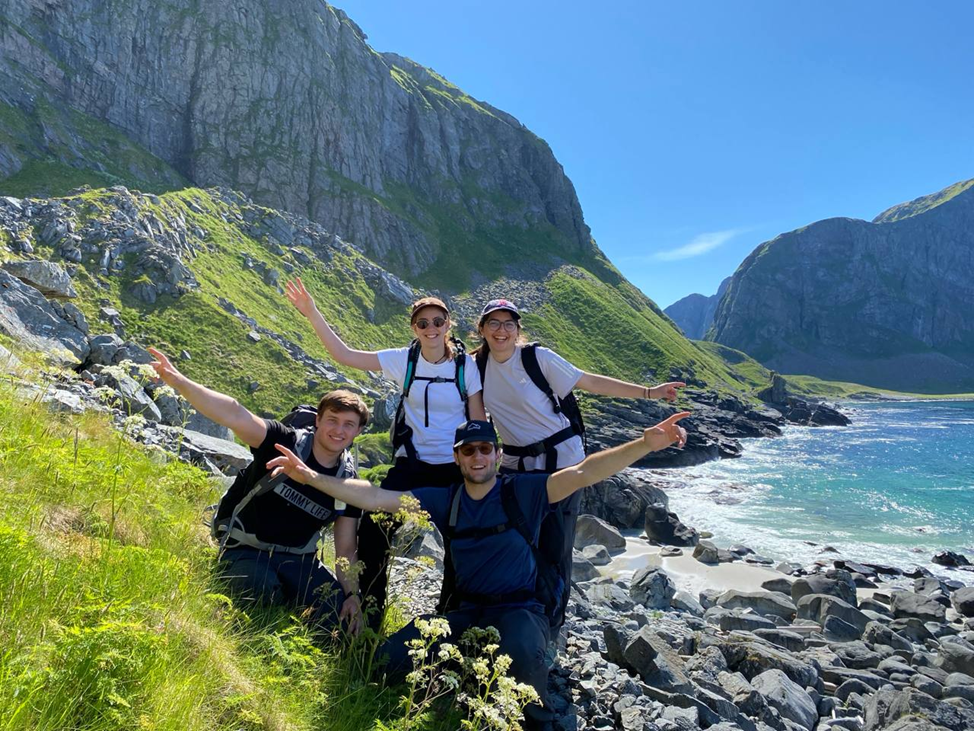
This experience of jointly planning complex itineraries, organising logistics, hiring a car and managing daily life in completely new surroundings not only made me much more independent, but also turned my university acquaintances into true close friends, with whom we will certainly continue to maintain close ties.
The semester I spent studying at the University of South-Eastern Norway was one of the most important stages in my professional and personal development. This programme allowed me to immerse myself fully in the European education system, where a solid theoretical foundation is inseparable from a strong practical component – from modelling complex processes in MATLAB and DIgSILENT PowerFactory to assembling circuits based on IGBT transistors with my own hands and testing high-voltage insulation.
As well as my academic achievements, this time has provided me with an incredible life experience. Norway has taught me to step outside my comfort zone. I am returning home not only with new knowledge, but also as a much more independent, self-assured person, inspired to achieve new things.
The practical experience and knowledge I have gained will form a solid foundation for my future academic and research activities in Ukraine. In particular:
Ensuring the stability of the power system when integrating renewable energy sources: Skills in analysing dynamic stability will be applied to solve a critically important task – the integration of distributed generation facilities into the interconnected power system. Understanding how inertia-free generation affects the grid will enable the development of measures for system-wide damping and the prevention of blackouts during emergency conditions.
A practical understanding of the principles of power electronics forms the basis for the development of modern energy storage systems and charging stations for electric transport. The knowledge gained will enable work on the creation of autonomous microgrids capable of ensuring an uninterrupted power supply to consumers in the event of a main grid outage.
Modernisation and diagnostics of high-voltage infrastructure: Experience in testing high-voltage insulation and studying switching equipment enables students to participate in real-world industrial projects involving the refurbishment of electrical substations. Knowledge of international standards for equipment reliability will be applied to improve the resilience of networks against short circuits and overvoltages.